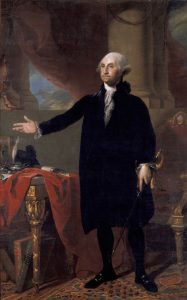
George Washington
With the adoption of the Constitution, Americans faced the arduous task of implementing a new government. One thing was certain—George Washington had to be the country’s first President. Preferring to remain retired at Mount Vernon, Washington agonized over re-entering public service.
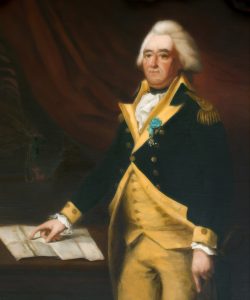
Anthony Wayne
Between 15 December 1788 and 10 January 1789 the states elected presidential electors who met in their home states on 4 February 1789 and unanimously elected Washington. After establishing a quorum, Congress, meeting in New York City, counted and certified the electoral vote count on 6 April. On that very day, General Anthony Wayne, writing from Georgia, implored Washington to accept the presidency. The task would be arduous, but he was capable. “The unbounded confidence placed in you, by every class of Citizens (which no other man cou’d expect or hope for) will contribute to render it less difficult—in fact—it is a Crisis that requires a Washington!” Many others encouraged Washington to accept the presidency.
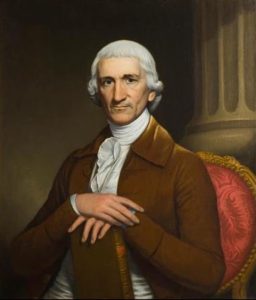
Charles Thomson
Congress appointed Charles Thomson, the first and only secretary of the Continental and Confederation Congresses, to inform Washington of his election. Thomson left New York City on 7 April and a week later, “impeded by tempestuous weather, bad roads, and the many large rivers,” arrived at Mount Vernon on 14 April when he officially informed Washington of his election. Two days later, Washington reluctantly left for New York City, recording his feelings in his diary: “About ten o’clock, I bade adieu to Mount Vernon, to private life, and to domestic felicity and, with a mind oppressed with more anxious and painful sensations than I have words to express, set out for New York . . . with the best dispositions to render service to my country in obedience to its call, but with less hope of answering its expectations.”
Celebrated all along the 250-mile trek northward, he arrived in New York on 23 April where the inaugural ceremony was held a week later.
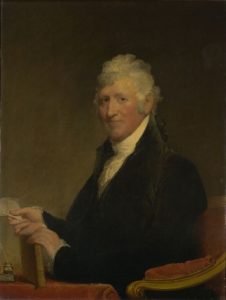
David Humphreys
Washington had asked Connecticut poet David Humphreys, a former aide-de-camp and advisor who was on a protracted visit to Mount Vernon, to draft his inaugural address. Several friends advised Washington not to use the 73-page draft that would have taken almost two hours to deliver. After painstakingly copying the speech, Washington agreed that it was too magisterial as well as far too long for the occasion. He asked James Madison to write another draft, outlining the things that should be included.
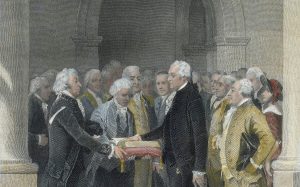
George Washington’s inauguration
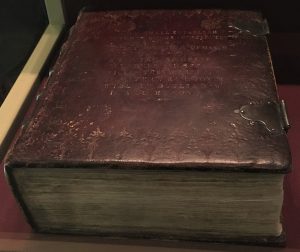
Washington’s inauguration bible
Washington, clad in a dark brown suit of Connecticut broadcloth with metal wing-spread eagle buttons, white silk stockings, and a magnificent ceremonial sword, took the oath of office about 1:00 pm on 30 April 1789, on the balcony of Federal Hall (the Old City Hall) located where Wall Street meets Broad and Nassau in New York City. New York’s Chancellor Robert R. Livingston, the highest ranking judicial officer in the state, administered the oath, which Washington recited with his hand placed upon a Bible. Livingston then proclaimed, “Long Live George Washington, President of the United States.” As the crowd shouted “God bless our Washington! Long live our beloved president,” Washington, Vice President John Adams, and the other attending dignitaries re-entered the building and proceeded to the Senate chamber where before a joint session of Congress Washington delivered his four-page address in about twelve minutes.
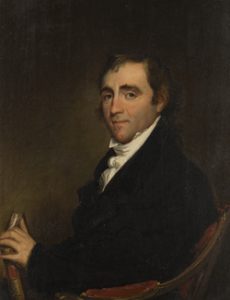
Fisher Ames
Massachusetts Congressman Fisher Ames sat close to Washington at the ceremony. Three days later, Ames wrote that “Time has made havoc upon his face.” The speech itself was dramatic. “His aspect grave, almost to sadness; his modesty, actually shaking; his voice deep, a little tremulous, and so low as to call for close attention . . . produced emotions of the most affecting kind upon the members. I . . . sat entranced. It seemed to me an allegory in which virtue was personified.”
In his speech, Washington expressed great anxiety. Although he preferred to spend “the asylum of my declining years” in retirement at Mount Vernon, he could not reject this latest call to duty. He understood “the magnitude and difficulty of the trust in which the voice of my Country called me.” He was uncertain whether he had the ability to succeed in leading the country’s “civil administration” under the new Constitution. “It would be peculiarly improper [at this time] to omit . . . my fervent supplications to that Almighty Being who rules over the Universe, who presides in the Councils of Nations, and whose providential aids can supply every human defect.” Only through the benediction of “the Great Author of every public and private good” would Americans retain their “liberties and happiness.”
Washington acknowledged that Americans had just passed through their second revolution—a peaceful one, changing “the system of their United Government, [through] the tranquil deliberation, and voluntary consent of so many distinct communities.” This revolution “cannot be compared with the means by which most Governments have been established.”
One duty of the executive department of the new government was to make proposals for Congress to consider. Instead, however, Washington acknowledged “the talents, the rectitude, and the patriotism” of the members of the first Congress. He was confident that “no local prejudices, or attachments; no separate views, nor party animosities, will misdirect the comprehensive and equal eye which ought to watch over this great Assemblage.” America’s “national policy, will be laid in the pure and immutable principles of private morality. . . . the propitious smiles of Heaven, can never be expected on a nation that disregards the eternal rules of order and right.” “The sacred fire of liberty, and the destiny of the Republican model of Government, are justly considered as deeply, perhaps as finally staked, on the experiment entrusted to the hands of the American people.”
Washington advocated that Congress propose amendments to the new Constitution not to change the structure of the government, but in the form of a bill of rights to ameliorate the fear expressed by Antifederalists during the ratification struggle. “A reverence for the characteristic rights of freemen, and a regard for the public harmony, will sufficiently influence” Congress’ deliberations on this matter.
Following the address, the company walked about 700 yards to St. Paul’s Episcopal Chapel for services conducted by the Rev. Dr. Samuel Provost, the newly-elected chaplain of the Senate. After the services, the President was escorted to his residence where he dined with a small group of friends and advisers. The inaugural events ended that evening with a brilliant display of fireworks.
Each house of Congress responded favorably to the speech. The House response, drafted by James Madison, said that Washington’s request for a bill of rights would “receive all the attention demanded by its importance; and will, we trust, be decided under the influence of all the considerations to which you allude.”
The Senate rejoiced with all Americans “that, in Obedience to the Call of our common Country, you have returned once more to public life.” They told Washington that “in you all Interests unite; and we have no doubt that your past Services, great as they have been, will be equalled by your future Exertions; and that your Prudence and Sagacity as a statesman will tend to avert the Dangers to which we were exposed, to give stability to the present Government, and Dignity and Splendor to that country, which your Skill and Valor as a Soldier, so eminently contributed to raise to independence and Empire.” The Senate promised to work with the President “in every Measure, which may strengthen the Union, conduce to the Happiness, or secure and perpetuate the Liberties of this great confederated Republic.” Washington thanked each house for the warm remarks and wrote that he would “readily engage” with them “in the arduous, but pleasing, task, of attempting to make a Nation happy.”
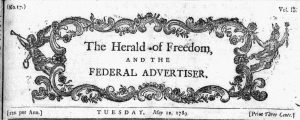
masthead for The Herald of Freedom
A correspondent in the Boston
Herald of Freedom, 12 May 1789, captured the feelings of Americans when they read the inaugural address that was widely reprinted in newspapers and pamphlets throughout the country.
“The late conduct of the President of the United States, says a correspondent, places in so interesting a point of view his truly illustrious character, as must endear him more than ever to his grateful and admiring countrymen—His disinterested refusal of all pecuniary emoluments—his mild, conciliating language—his strongly implied opinion in favour of such alterations as shall improve, and not injure the Constitution—his truly republican address to the Senate and House of Representatives—all prove him, beyond controversy, the same amiable, honest, and GREAT MAN, the same real and unaffected friend to the PEOPLE, he always has been.”