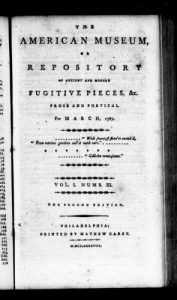
Title page of American Museum, v. I, No. 3
In July 1788, Mathew Carey, a twenty-eight-year-old Irish immigrant living in Philadelphia, looked back over the past year which had been eventful for both Carey and his adopted country. In 1787 a Convention of delegates from twelve of the country’s thirteen states proposed a new form of government that the American people debated for over a year before agreeing to its ratification. This was also the year Carey began publishing the
American Museum, a monthly literary magazine filled with articles on politics, economics, medicine, agriculture, patriotism, religion, and morality, as well as poetry, humor, and satire.
As Carey observed the debate over the new Constitution, he realized what a momentous event was occurring. He had fled his native Ireland for fear of being arrested for sedition for publishing a newspaper that espoused Irish nationalism. But in America, the government itself encouraged the public debate over the proposed Constitution, which, if adopted, would totally supplant the current government. Surely, Carey thought, this must be an extraordinary event in the annals of mankind—men deciding peacefully and rationally on the form of government under which they wished to live. Other Americans had similar feelings. Alexander Hamilton, also an immigrant, described such a situation in his opening number of
The Federalist when he wrote that “It has been frequently remarked, that it seems to have been reserved to the people of this country, by their conduct and example, to decide the important question, whether societies of men are really capable or not, of establishing good government from reflection and choice, or whether they are forever destined to depend, for their political constitutions, on accident and force.” Carey wondered what circumstances could have produced such a unique occurrence. He believed that the answer to this question lay scattered among the records of the past quarter century—a quarter century in which Americans had intensely debated the nature of government and how best to preserve liberty. Never before or since have Americans been so enrapt for so long a time in a public debate. And it was not merely theoretical; Americans had gone to war and died over the issues involved in that debate.
Realizing the importance of this debate, Carey had a compelling desire to search for the records of the debate and publish them in his magazine. “Posterity,” he wrote in the preface to the third volume of his
Museum, “will lament the inattention of their ancestors. . . . The history of the most important revolution that ever took place, will probably in many places be involved in obscurity, for want [i.e., lack] of papers at present little prized or regarded.” To guard against this loss, Carey proposed to publish important printed and manuscript documents in his monthly magazine.
* * * *
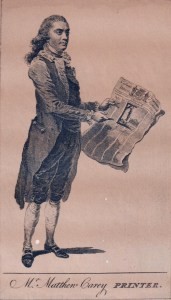
Mathew Carey as a young printer
While fearing imprisonment for sedition, nineteen-year-old Mathew Carey left Ireland in 1779 and took up residence in Passy, a village near Paris. Here he met Benjamin Franklin and worked on Franklin’s personal press at his residence also in Passy. Carey also met the Marquis de Lafayette who quizzed him for information that might assist in a French invasion of Ireland that would provoke an uprising against the British. In 1781, Carey returned to Dublin where he edited the
Freeman’s Journal until October 1783 when, with the financial assistance of his father, he founded and edited the
Volunteer’s Journal, a bi-weekly newspaper that vigorously supported civil and religious liberties and a republican form of government for Ireland.
Arrested for sedition by the Irish House of Commons and imprisoned for a month in Dublin’s Newgate Prison, Carey was released by order of the lord mayor of Dublin after the Commons adjourned. However, fearing further prosecution, Carey (disguised as a woman) boarded a ship bound for America in September 1784. On 1 November 1784 he arrived in Philadelphia, where he resided for the rest of his life. Franklin wrote to Lafayette alerting him of Carey’s expected arrival in America. While Lafayette visited America for five months in 1784, he met with Carey in Philadelphia and confidentially gave him $400 to assist in starting a newspaper. In early January 1785, Carey purchased a dilapidated old press and later in that same month established the bi-weekly
Pennsylvania Evening Herald. After a slow start, the publication established Carey’s reputation for excellent reports of the debates in the Pennsylvania Assembly.
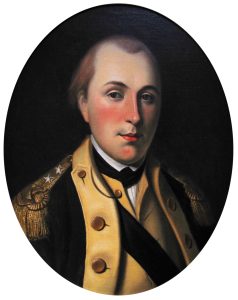
Marquis de Lafayette
As he ended his 1784 visit to America, Lafayette wrote to James Madison on 17 December 1784 describing Carey as a “Martyr to the cause of liberty.” Four days later, Lafayette wrote to George Washington telling him that Carey had “been obliged to fly for his life,” and was living as a boarder on Front Street, “where he is going to set up a paper.” Lafayette asked both Madison and Washington to encourage Carey and subscribe to his newspaper. According to Lafayette, Carey “now is an
American.”
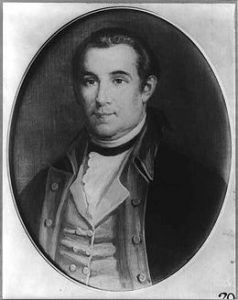
Eleazer Oswald
An ardent champion of Irish freedom and immigrant rights, Carey alienated fellow Philadelphia printer Eleazer Oswald. Carey sided with the democratic state Constitutionalist Party, while Oswald championed the more conservative Republican Party. Both insulted each other in print. After Carey printed
The Plagi-Scurriliad, a bitter poem satirically dedicated to Colonel Oswald, Oswald challenged Carey to a duel. Oswald, a thirty-six-year-old former lieutenant colonel of artillery in the Continental Army and an expert marksman with a volatile temper, frequently challenged adversaries, especially competing printers, some of whom out of fear avoided contact with Oswald. Carey, who walked with a considerable limp due to a deformed foot, felt obliged to accept the challenge in order to maintain his honor, even though while in Ireland in 1777 he had published a pamphlet denouncing duels. The duel took place near Camden, New Jersey, on 18 January 1786. A musket ball hit Carey’s thigh just above the knee of his leg with the deformed foot. Amputation was feared, but Carey recovered after an eighteen-months’ convalescence.
In October 1786, Carey and several partners commenced publication of the monthly
Columbian Magazine, but he withdrew almost immediately and started
The American Museum; or Repository of Ancient and Modern Fugitive Pieces &c. Prose and Poetical. Carey published a total of 72 issues of the magazine—one each month from January 1787 through December 1792. Six monthly issues were bound together in twelve separate volumes, each with its own preface and index. In the preface to the second volume, Carey informed his readers that he had obtained a new smaller-sized type that would save about one-third the space needed by the previous type. With the publication of the seventh volume (January 1790), the title was changed to
The American Museum, or Universal Magazine that included an expanded number of entries “devoted to entertainment.”
The
American Museum was antedated and was usually published during the first week of the subsequent month—e.g., the January 1787 issue was published on 1 February and the March 1787 issue on 4 April. In 1787 and 1788 each monthly
Museum averaged between 90 and 100 pages. The magazine sold for eighteen shillings per annum or for twenty-five cents a copy. When its first issue appeared, which included Thomas Paine’s
Common Sense, “there were not twenty subscribers.” But, with confidence that he had seized upon a successful formula, the optimistic young Irishman printed a thousand copies of his first effort. The new magazine was enthusiastically received, and Carey soon realized that he had woefully underestimated his market as all thousand copies quickly sold. By June 1787 about 500 people had subscribed. In October 1788 Carey stated that he had about 1,000 subscribers and that he printed 2,500 copies monthly as he was able to “dispose of a considerable number singly.”
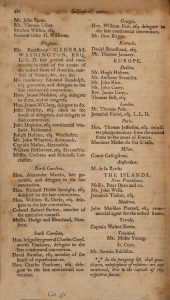
State subscriber list, American Museum, v. 3.
A prefatory list of subscribers sometimes arranged state by state (from north to south) appeared in the beginning of the first six volumes. The subscriber’s residence, occupation, and political office were often included, especially if the subscriber was a member of Congress or the “Continental Convention.” Notable subscribers included George Washington, Benjamin Franklin, John Dickinson, Don Diego de Gardoqui, Alexander Hamilton, John Jay, Thomas Jefferson, William Samuel Johnson, Rufus King, Henry Knox, William Livingston, James Madison, George Mason, Gouverneur Morris, Robert Morris, the Comte de Moustier, Charles Pinckney, David Ramsay, Edmund Randolph, Benjamin Rush, and Sir John Temple. Subscribers resided not only in America, but also in Europe and the West Indies.
In 1791 Carey had forty-eight agents, often newspaper printers and booksellers, who solicited, accepted, and fulfilled subscriptions in towns throughout the country. One of Carey’s agents, Nathaniel Hazard, a New York City merchant, described the
Museum as a “very patriotic and useful Work” “calculated to dispel the Clouds of political Ignorance, and instruct and enlighten America.” In 1788, the French traveler Brissot de Warville praised Carey for his “great industry” and “much knowledge” while ranking the
Museum as “equal to the best periodicals of Europe.”
The
Museum was filled with pieces dealing with politics, economics, medicine, agriculture, patriotism, satire and humor, religion, morality, and poetry that were mostly either reprinted from newspapers or excerpted from pamphlets. Carey himself stated that “This work lays little or no claim to originality. Humbler—perhaps not less useful—is its design. To
preserve for posterity—as well as to
disseminate among the present generation—valuable fugitive (i.e., isolated) publications, hastening to oblivion—are its primary objects. Original writings, however, are by no means excluded” and became more frequent in the later issues. Carey now and then even contributed an original piece of his own. Starting with the issue of March 1791, the
Museum opened with a page-long meteorological table for Philadelphia for the previous month that included barometric pressure, temperature, wind, and a general description of the weather. (The March 1791 issue contained tables for both January and February.)
During its first year and a half, the
Museum understandably concentrated heavily on political matters, consistently supporting a strengthened central government during the debate over ratifying the federal Constitution. For example, two of the five lead articles in the first issue of the
Museum advocated a strong central government. Carey maintained his Federalist bias by reprinting individual and serialized Federalist essays, proceedings of town and county meetings supporting the Constitution, speeches by leading Federalists, and the forms of ratification by state conventions.
No Antifederalist items were published in the
Museum before November 1787—a fact lamented by a correspondent in the 20 October 1787 issue of the Philadelphia
Independent Gazetteer, published by Eleazer Oswald. The correspondent “observed with sorrow that [Carey] although he seems to have been the martyr of liberty in his own country, has not shown of late a similar disposition in America, as the pieces recorded in the Museum on the subject of the federal constitution, many of which are very trifling, are all evidently on
one side of the question.” However, beginning with the October 1787 issue—published on 3 November—the
Museum began reprinting Antifederalist objections to the Constitution, such as those by Elbridge Gerry, Richard Henry Lee, George Mason, Robert Yates and John Lansing, Jr., “An Officer of the Late Continental Army,” and the minorities of the Pennsylvania Assembly and the Pennsylvania Convention.
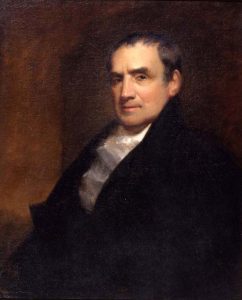
Mathew Carey portrait, 1825
Carey defended his selection policy in the preface to his January 1788 issue, where he declared himself to be a Federalist. His New York agent, Nathaniel Hazard, agreed, writing that Carey, “a Gentleman, and a man of Letters . . . is a Federalist to Enthusiasm” (to Theodore Sedgwick, 5 June 1788). Carey said that he had published “valuable pieces on each side” even though “zealots of both parties” found that policy objectionable. Regrettably, he admitted that he had “lost a few subscribers” after publishing certain Federalist and Antifederalist items. Six months later, in the preface to the July issue, Carey reiterated his position and expressed the hope that his
Museum did not merit “the title of
federal—or
antifederal—but
impartial.”
In late June 1788, Washington wrote to Carey praising his literary efforts: “a more useful literary plan has never been undertaken in America, or one more deserving public encouragement. By continuing to prosecute that plan with similar assiduity and discernment, the merit of your Museum must ultimately become as well known in some Countries of Europe as on this Continent; and can scarcely fail of procuring an ample compensation for your trouble & expence.” Additionally, Washington hoped that publications such as the
American Museum should “spread through every city, town & village in America.” He considered “such easy vehicles of knowledge, more happily calculated than any other, to preserve the liberty, stimulate the industry and meliorate the morals of an enlightened and free People.” With Washington’s approval, Carey published an excerpt of Washington’s letter as a preface to the fourth volume of the
Museum (July–December 1788) and dedicated the sixth volume (July–December 1789) to Washington thanking him for his “approbation and patronage” that Carey would “regard as one of the most pleasing circumstances of my life.”
Throughout the six years during which the
American Museum was published, Carey struggled financially finding himself “almost daily on the verge of bankruptcy.” Although he had many subscribers, most of them received the
Museum on credit and often did not make timely payments. Several of Carey’s prefaces to the
Museum contained pleas for punctual payment, the lack of which always endangered newspapers and magazines characterized by Carey like ships subject to being wrecked on the shoals of non-payment. Although each individual subscriber’s fee was small, “the aggregate is the only fund for defraying the great and inevitable expences of the undertaking. These cannot be deferred.” Distribution of the
Museum was also cumbersome and costly, especially after postage rates were raised. Carey gave no indication that he was stopping the publication of the
Museum except that the index to Volume XII was headed: “Index to the Twelfth and last Volume.” At the end of the index to this volume appears the terse announcement: “end of the american museum.”
Mathew Carey continued in the printing business operating one of the most prominent book publishing houses in the first quarter of the nineteenth century. His company printed the first American edition of the Catholic Bible in 1789–90 and also several editions of the King James version of the Bible. From 1794 through 1796 he published three atlases: of the European war (1794), of the American states with a chart of the West Indies (1795), and of the rest of the world (1796). Updated editions of these atlases were published over the next twenty years.
Carey’s publications concentrated heavily on political economics. He supported much of Alexander Hamilton’s economic plan including a national bank, manufactures, protective tariffs, and improvements in roads and canals. He favored a strong American navy and supported the War of 1812. He opposed the New England separatist movement and his 1814 book
Olive Branch advocated national unity. Much of this book was adapted by Henry Clay in his American System. Carey retired in 1825 leaving the publishing business to his son and son-in-law.