
Lady Justice
The concept of the due process of law is guaranteed in the Fifth and Fourteenth Amendments to the U.S. Constitution. It ensures that neither the federal nor, following incorporation by the Supreme Court, state governments shall deprive anyone “of life, liberty or property without the due process of law.” Due process is not a single, specific right. Rather, it is a blend of rights, customs, procedures, and legal traditions inherited from Britain that have evolved over the centuries along with the broader concept of “justice.”

King John signing the Magna Carta
By the eighteenth century, the concept of fairness under the law was well established in America through both common law and specific laws and constitutional protections. However, these protections were typically phrased in a more limited term: “the law of the land.” The modern use of the phrase “due process of law” began to emerge in response to growing concerns by the states about federal power, particularly during the debates over the Impost of 1783.
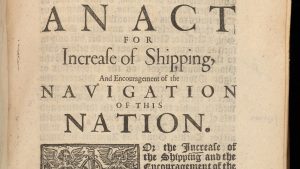
Navigation Act
Proposed by the Confederation Congress, the Impost would have authorized a five percent tariff specifically earmarked to pay the wartime debt. Americans in every state saw the danger of a powerful potential federal court to try individuals charged with violating the federal tariff. For decades before the Revolution, Americans (both merchants and colonial customs collectors) had become adept smugglers in circumventing the British navigation acts first passed in 1651. Formerly thought of as patriots, Congress now considered these smugglers as criminals to be tried in sometimes distant federal courts without the protections afforded in state constitutions and laws. To many Americans this smacked of the re-establishment of the hated British vice admiralty courts that tried maritime cases in distant courts without jury trials under the provisions of the civil law instead of the common law. As a result, all of the states that adopted the Impost added limitations on the Impost requiring that only state courts could try cases concerning the Impost. Thereby, the defendants would benefit from their state’s constitutional protections under “the law of the land.”
In January 1787, without a bill of rights or specific protections embodied in their state constitution, New Yorkers adopted a statutory bill of rights with thirteen articles that protected judicial rights. Four of these articles (numbers two through five) included protections under the due process of law:
Second: That no Citizen of this State shall be taken or imprisoned, or be disseised of his or her freehold or liberties or free customs, or outlawed, or exiled, or condemned, or otherwise destroyed, but by lawful judgment of his or her Peers or by due process of law.
Third: That no Citizen of this State shall be taken or imprisoned for any offence, upon petition or suggestion, unless it be by indictment or presentment of good and lawful men of the same neighbourhood, where such deeds be done, in due manner, or by due process of law.
Fourth: That no person shall be put to answer without presentment before Justices, or matter of record, or due process of law, according to the law of the land, and if any thing be done to the contrary, it shall be void in law and holden for error.
Fifth: That no person, of what estate or condition soever, shall be taken, or imprisoned, or disinherited, or put to death without being brought to answer by due process of law, and that no person shall be put out of his or her franchise or freehold, or lose his or her life or limb, or goods and chattels, unless he or she be duly brought to answer, and before-judged of the same by due course of law; and if any thing be done contrary to the same it shall be void in law and holden for none.
Although these protections were never tested, because the Impost of 1783 was never adopted or implemented, this Impost episode revealed a deep American understanding that government power must be limited by clearly articulated procedures and rights. As in Britain, Americans believed that certain personal liberties must not be infringed upon without due process of law.
The newly proposed Constitution of 1787 re-kindled fears of an overreaching federal judiciary, especially because it lacked a bill of rights to clearly safeguard due process. Consequently, Antifederalists in nine of the state ratifying conventions recommended that the first federal Congress should consider amendments. Five of these nine lists of recommended amendments included a provision that guaranteed protections under “the law of the land”—Pennsylvania, Maryland, Virginia, North Carolina, and Rhode Island. Only New York’s convention, drawing on the recently adopted state statutory bill of rights, provided for the protection under “the due process of the law,” specifying “That no Person ought to be taken imprisoned, or disseised of his freehold, or be exiled or deprived of his Privileges Franchises, Life, Liberty or Property, but by due process of Law.”

James Madison
On June 8, 1789, in the first U.S. House of Representatives, James Madison introduced a list of proposed amendments. Although his own Virginia convention had favored “the law of the land” phraseology, he adopted New York’s phrasing and included “due process of law” in what would become the Fifth Amendment. Congress agreed to Madison’s amendment in September 1789, and by December 1791, three-quarters of the state legislatures ratified ten of Congress’ proposed amendments including the protection of the due process of law provision of the Fifth Amendment.
The due process clause fundamentally expanded personal protections by requiring the government to observe or offer fair procedures, whether or not those procedures were specifically embodied in law. Over the last two centuries, the U.S. Supreme Court has interpreted this clause to provide broad and evolving guarantees of individual rights under both procedural and substantive due process.