Shortly after the destruction of the Twin Towers at New York’s World Trade Center in September 2001, the University of Wisconsin–Madison Library chose to commemorate the tragedy by publishing a pamphlet containing the Declaration of Independence, the Constitution, and the Bill of Rights. Kenneth Frazier, the director of the library, and a colleague, visited my office asking if I would write the pamphlet’s introduction. Respectfully, I declined, suggesting someone who I thought was better qualified to take on the task. I recommended Stephen E. Lucas, a professor in the Department of Communication Arts at the UW, who had already written extensively on the rhetorical significance of these documents. I immediately telephoned Professor Lucas to see if he would accept the assignment. He agreed. Soon after receiving Lucas’ introduction, Ken Frazier asked me to write an Afterword, which appears at the end of this blog. The pamphlet was published in 2002 and was distributed free of charge.
* * * *
Introduction
By Stephen E. Lucas
The Declaration of Independence, the Constitution, and the Bill of Rights constitute the great trilogy of America’s founding documents. Composed in the heat of partisan strife to achieve immediate political objectives, their words echo across the centuries in a timeless expression of the American spirit and principles of government. An integral part of our country’s history, they are also a vital part of its present. National leaders turn to them for inspiration in moments of crisis; ordinary citizens revere them as the sacred charters of American freedom; activists claim their support for causes across the political spectrum; scholars debate the meaning of their words with a passion that would astound the men who penned them more than 200 years ago.
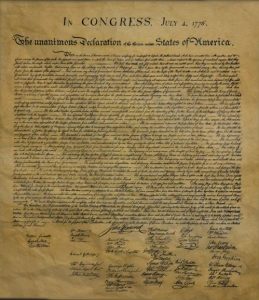
Declaration of Independence
And what magnificent words they are. “We hold these Truths to be self-evident, that all Men are created equal, that they are endowed by their Creator with certain unalienable Rights, that among these are Life, Liberty and the Pursuit of Happiness.” This peerless sentence from the Declaration of Independence is, like the rest of the document, a model of literary as well as political expression. In addition to providing what Abraham Lincoln called “a standard maxim for free society,” the Declaration has been emulated, in form and content, by writers around the globe. It is the verbal representation of the promise of American democracy in the same way that the Statue of Liberty is the visual representation of that promise.
We have not always been consistent in translating the principles of the Declaration into practice. Even as Americans rallied around its words during the war for independence, the existence of slavery pointed to the gap between ideals and reality. So, too, did the fact that women were not accorded the same rights as men. Today we continue the struggle to live up to the lofty phrases of the Declaration. Yet the very fact that those phrases exist has made an incalculable difference. They have been used on countless occasions to justify broadening the lines of power and privilege in American life and in struggles for human rights throughout the world. Although written to justify independence from Great Britain, they have taken on a life of their own that far transcends the circumstances of their creation.
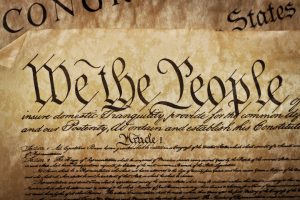
United States Constitution
The opening words of the Constitution—“We the people of the United States, in order to form a more perfect Union”—are equally lustrous. Unlike the Declaration, however, the remainder of the Constitution is written in an idiom befitting its role as the fundamental law of the land. While the impact of the Declaration on American history has come primarily from its moral force, the impact of the Constitution has come from its legal authority. Yet that authority is not absolute. “We are under a Constitution,” wrote Charles Evans Hughes in 1907, “but the Constitution is what the judges say it is.” The Constitution is a living document that is constantly being interpreted and reinterpreted as successive generations of jurists apply it to changing legal, social, and political circumstances.
The malleability of the Constitution has been a source of dismay to those Americans who prefer that the courts adhere to the original intent of the Founders when deciding cases. But the fact is that the Founders did not speak with a single voice. There were multiple viewpoints expressed during the Constitutional Convention, and the Constitution could not have been approved without a number of compromises designed to resolve differences among the delegates. Trying to determine
the position of the Founders on almost any issue relative to contemporary case law is an impossible task.
Rather than being a weakness of the Constitution, what Franklin Roosevelt called its “marvelously elastic” quality is perhaps its greatest strength. In Roosevelt’s estimation, it is why “our constitutional system has proved itself the most superbly enduring political mechanism the modern world has produced.” The British leader William Gladstone was no less effusive in his praise of the Constitution, calling it “the most wonderful work ever struck off at a given time by the brain and purpose of man.” Today, more than 200 years after its creation, the Constitution remains America’s single most important contribution to the advancement of political science and practical government.
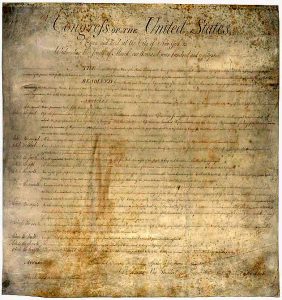
Bill of Rights
The Bill of Rights, which consists of the first ten amendments to the Constitution, was not part of the original document. The amendments were added to allay concerns that the Constitution did not provide explicit safeguards for what Richard Henry Lee called “those essential rights of mankind without which liberty cannot exist.” Most of the liberties secured by the Bill of Rights—religion, speech, press, assembly, trial by jury, freedom from unreasonable searches and seizures, protection of due process—had roots in English constitutional law and were listed in the Declaration of Independence as rights violated by Parliament and King George III.
James Madison, who was almost single-handedly responsible for getting the amendments approved by Congress and sent to the states for ratification, had wanted to incorporate them into the original text of the Constitution, rather than having them stand alone as separate codicils. Fortunately, Congress resisted, thereby giving the amendments a unity and visibility they would not have acquired otherwise. Although other amendments have been added over the years, the first ten have been revered as expressing, in Madison’s words, “fundamental maxims of free government.” Time and again they have been invoked to protect civil liberties and to forestall the usurpation of power by the executive or legislative branches.
Taken together, the Declaration of Independence, the Constitution, and the Bill of Rights form the cornerstone of American democratic representative government. Every citizen should be familiar with their words and tenets. Reprinting the documents together and in their entirety provides an opportunity for readers to further their historical understanding and to appreciate more fully the principles that have helped make America what Abraham Lincoln, in the darkest days of the Civil War, deemed the “last, best hope of earth.”
* * * *
Afterword
By John P. Kaminski
Each of the documents in this American trilogy is a fundamental state paper and each was ultimately embraced by the American people. After Congress approved the Declaration of Independence it was immediately set into type and read to the public in Philadelphia, to the army in New York and New England, and to the people throughout the country. At least a third of all Americans opposed the Declaration because they wanted to remain within the British Empire. Another third was either apathetic or because of their pacifism did not relish the thought of a war over the question of independence. The final third of Americans, however, not only endorsed Congress’ decision to separate, but they passionately embraced the philosophy of the Declaration composed so eloquently by Thomas Jefferson. Within a few years Americans came to view the Declaration of Independence as an icon—a sacred text.
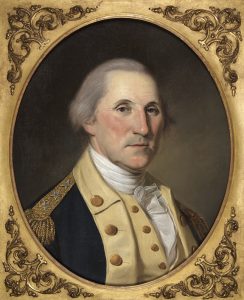
George Washington
In September 1787, as the Constitutional Convention finished its four-month ordeal of drafting a new Constitution that would greatly strengthen the central government’s authority, the delegates agreed that they should address the American people. This address was put into the form of a letter from the president of the Convention—George Washington—to the president of Congress. Affixing Washington’s name highlighted the fact that the great American hero endorsed the new Constitution. Washington’s letter indicated that whenever people in society create a government for themselves or whenever sovereign states create a federal government certain rights must be surrendered. It is difficult, Washington wrote, “to draw with precision the line between those rights which must be surrendered, and those which may be reserved.” In deliberating on this difficult subject, Washington said that the delegates kept the ultimate goal in view—the preservation of the Union and the strengthening of the central government, “in which is involved our prosperity, felicity, safety, perhaps our national existence.” With this central focus, each state delegation was “less rigid on points of inferior magnitude, than might have been otherwise expected.” Thus the Constitution was “the result of a spirit of amity, and of that mutual deference and concession which the peculiarity of our political situation rendered indispensable.” Washington’s letter was reprinted along with the Constitution throughout the country in newspapers, broadsides, and pamphlets, and it helped to achieve ratification, despite severe doubts about the Constitution by many Americans. In fact years later, James Madison suggested that “many parts” of the Constitution “would have been promptly rejected” if they had been “separately proposed,” and yet taken together as a whole—as a collection of compromises—it was unanimously adopted.
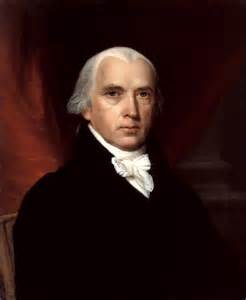
James Madison
During the yearlong debate over the ratification of the Constitution, a key issue was whether the Constitution was the fulfillment of the principles of 1776 or a step backwards. A majority of Americans finally determined that they wanted the Constitution adopted but that the line between the powers given to the central government and the rights reserved to the people had not been stated explicitly enough. Amendments were needed to limit the federal government’s authority. In a monumental speech delivered on June 8, 1789, in the first House of Representatives, James Madison championed a bill of rights. Madison said that Congress ought not to disregard the wishes of the American people, “but, on principles of amity and moderation, conform to their wishes, and expressly declare the great rights of mankind secured under this Constitution.” Congress accepted Madison’s recommendation and submitted amendments in the form of a bill of rights to the states, which the states readily adopted.
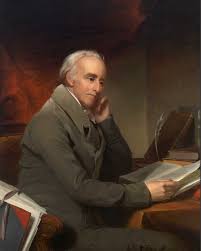
Benjamin Rush
In January 1787 Dr. Benjamin Rush, a Philadelphia physician and a signer of the Declaration of Independence, wrote that there was “nothing more common than to confound the terms of THE AMERICAN REVOLUTION with those of THE LATE AMERICAN WAR. The American war is over,” Rush said, “but this is far from being the case with the American revolution. On the contrary, nothing but the first act of the great drama is closed. It remains yet to establish and perfect our new forms of government; and to prepare the principles, morals, and manners of our citizens, for these forms of government, after they are established and brought to perfection.” With the ratification of the Constitution and adoption of the Bill of Rights, the American Revolution came to a successful conclusion. With subsequent amendments that guaranteed the rights of all Americans, the great American trilogy continues to direct our government and serves as the philosophical bedrock of our society.