Patrick Henry: “He Spoke as Homer Wrote”
How can anyone truly capture the power of Patrick Henry before a live audience? In truth, it’s nearly impossible.
Consider this: on 6 June 1791, President George Washington appeared at the Charlotte County courthouse in Virginia. Among the crowd was Richard Venable, a twenty-eight-year-old lawyer from Prince Edward County, who wrote in his diary: “Great Anxiety in the people to see Gen’l. Washington. Strange is the impulse which is felt by almost every breast to see the face of a great good man.” The sensation, Venable added, was “better felt than expressed.” That’s exactly what it was like to witness Patrick Henry speaking. You didn’t just hear him—you experienced him. You felt him. And only then could you understand his power.
 A Henry speech was the Super Bowl, the seventh game of the World Series, and the championship game of the NCAA basketball tournament all rolled into one. This was great entertainment; this was stimulating and inspirational; this was one of those events that you remember forever. For however long Henry would speak—half an hour, an hour, or maybe even three hours—he would hold his audience spellbound. They would be mesmerized. Those who agreed with his position came away more convinced than ever before. Those who disagreed with him, wondered how the audience, including themselves, had been captivated for so long by this American “Demosthenes.” Thomas Jefferson, one of Henry’s adversaries, later admitted: “Although it was difficult when he had spoken, to tell what he had said, yet while he was speaking, it always seemed directly to the point. When he had spoken in opposition to my opinion, had produced a great effect, & I myself been highly delighted & moved, I have asked myself when he ceased, ‘What the devil has he said,’ & could never answer the enquiry.”
Writing to his wife from the First Continental Congress, Connecticut delegate Silas Deane echoed this awe: “[Mr. Henry is] the completest Speaker I ever heard . . . but in a Letter I can give You no Idea of the Music of his Voice, or the highwrought, yet Natural elegance of his Style, & Manner.” Henry Knox of Massachusetts, the Confederation’s Secretary at War, described Henry as an “overwhelming torrent,” while French chargé d’affaires Louis-Guillaume Otto called him a “Man of the people, whom nature has given an amazing facility in a spirited manner. His eloquence astonishes and condemns even the most skillful adversaries to silence. He is the head of the plebeian party.” After meeting and listening to Henry’s speeches in the Virginia provincial convention, George Mason declared: “He is by far the most powerful speaker I ever heard. Every word he says not only engages but commands the attention; and your passions are no longer your own when he addresses them. But his eloquence is the smallest part of his merit. He is in my opinion the first man upon this continent, as well in abilities as public virtues, and had he lived in Rome about the time of the first Punic war (264–261 bc), when the Roman people had arrived at their meridian glory, and their virtue not tarnished, Mr. Henry’s talents must have put him at the head of that glorious Commonwealth.”
John Marshall once remarked that Patrick Henry had a knack for always making his opponent appear in the wrong while casting himself as the innocent party: “ ’Tis his peculiar excellence when he altercates to appear to be drawn unwillingly into the contest & to throw in the eyes of others the whole blame on his adversary. His influence is immense.”
A Henry speech was the Super Bowl, the seventh game of the World Series, and the championship game of the NCAA basketball tournament all rolled into one. This was great entertainment; this was stimulating and inspirational; this was one of those events that you remember forever. For however long Henry would speak—half an hour, an hour, or maybe even three hours—he would hold his audience spellbound. They would be mesmerized. Those who agreed with his position came away more convinced than ever before. Those who disagreed with him, wondered how the audience, including themselves, had been captivated for so long by this American “Demosthenes.” Thomas Jefferson, one of Henry’s adversaries, later admitted: “Although it was difficult when he had spoken, to tell what he had said, yet while he was speaking, it always seemed directly to the point. When he had spoken in opposition to my opinion, had produced a great effect, & I myself been highly delighted & moved, I have asked myself when he ceased, ‘What the devil has he said,’ & could never answer the enquiry.”
Writing to his wife from the First Continental Congress, Connecticut delegate Silas Deane echoed this awe: “[Mr. Henry is] the completest Speaker I ever heard . . . but in a Letter I can give You no Idea of the Music of his Voice, or the highwrought, yet Natural elegance of his Style, & Manner.” Henry Knox of Massachusetts, the Confederation’s Secretary at War, described Henry as an “overwhelming torrent,” while French chargé d’affaires Louis-Guillaume Otto called him a “Man of the people, whom nature has given an amazing facility in a spirited manner. His eloquence astonishes and condemns even the most skillful adversaries to silence. He is the head of the plebeian party.” After meeting and listening to Henry’s speeches in the Virginia provincial convention, George Mason declared: “He is by far the most powerful speaker I ever heard. Every word he says not only engages but commands the attention; and your passions are no longer your own when he addresses them. But his eloquence is the smallest part of his merit. He is in my opinion the first man upon this continent, as well in abilities as public virtues, and had he lived in Rome about the time of the first Punic war (264–261 bc), when the Roman people had arrived at their meridian glory, and their virtue not tarnished, Mr. Henry’s talents must have put him at the head of that glorious Commonwealth.”
John Marshall once remarked that Patrick Henry had a knack for always making his opponent appear in the wrong while casting himself as the innocent party: “ ’Tis his peculiar excellence when he altercates to appear to be drawn unwillingly into the contest & to throw in the eyes of others the whole blame on his adversary. His influence is immense.”
 Gouverneur Morris of Pennsylvania, a great writer and orator himself, described Henry as “most warm and powerful in Declamation being perfectly Master of Action, Utterance and the Power of Speech to stir Men’s Blood.” Jefferson, ever the reluctant admirer, recalled that Henry’s “eloquence was peculiar; if indeed it should be called eloquence, for it was impressive & sublime beyond what can be imagined. . . . His person was of full size, & his manner & voice free & manly. His utterance neither very fast nor very slow. His speeches generally short from a quarter to an half hour. His pronunciation, was vulgar & vicious, but it was forgotten while he was speaking.” Governor Edmund Randolph agreed. Though Henry’s “language, pronunciation, and gestures” were sometimes criticized “profusely,” these perceived flaws only made him more compelling. His “irregularity in . . . language,” his “homespun pronunciation,” and his “degree of awkwardness in the cold commencement of his gestures” merely served as a prelude to gain the attention of his audience. As Randolph put it: “Pronunciation which might disgust in a drawing room may yet find access to the hearts of a popular assembly.” Spencer Roane, a prominent attorney, Virginia state senator, and Patrick Henry’s son-in-law, reminisced “that although his language was plain, and free from unusual or highflown words, his ideas were remarkably bold, strong, and striking. By the joint effect of these two faculties, I mean of the power of his tone of voice and the grandness of his conceptions, he had a wonderful effect upon the feelings of his audience.”
No one, according to Jefferson, could match “the poetical fancy of Mr. Henry, his sublime imagination, his lofty and overwhelming diction.” His gestures were few at first, but as the intensity of his oratory mounted, they seemed to be prompted by nature. His imagination painted the soul and “eclipsed the sparklings of art. . . . He possessed a vein of sportive ridicule, but without arrogance or dictatorial malignity. . . . In others rhetorical artifice and unmeaning expletives have been often employed as scouts to seize the wandering attention of the audience; in him the absence of trick constituted the triumph of nature. His was the only monotony which I ever heard reconcilable with true eloquence; its chief note was melodious, but the sameness was diversified by a mixture of sensations which a dramatic versatility of action and of countenance produced. His pauses, which for their length might sometimes be feared to dispel the attention, riveted it the more by raising the expectation of renewed brilliancy. . . . His style of oratory was vehement, without transporting him beyond the power of self-command or wounding his opponents by deliberate offense . . . His figures of speech, when borrowed, were often borrowed from the Scriptures. . . . His lightning consisted in quick successive flashes, which rested only to alarm the more. His ability as a writer cannot be insisted on, nor was he fond of a length of details; but for grand impressions in the defense of liberty, the Western world has not yet been able to exhibit a rival.” Randolph described Henry in an assembly as “all powerful,” while Madison called him “omnipotent.” George Lee Turberville, a Richmond County planter who was serving in the Virginia House of Delegates, called Henry the “great high priest” of the people, while Washington said of Henry that in the Virginia legislature he was more powerful than a French king. “He has only to say let this be Law—and it is Law.” To Jefferson, Henry appeared “to speak as Homer wrote.” Late in the Virginia ratifying convention on June 24, 1788, as the vote on the Constitution approached, a violent storm was brewing when Henry addressed the delegates. Rising to a crescendo as the first lightning flashed and the thunder boomed, Henry “seemed to rise on the wings of the Tempest to seize upon the Artillery of Heaven and direct it against his adversaries.” The frightened delegates rushed out of the building without bothering to formally adjourn.
Henry’s friends felt that his power emanated from his “deep and correct knowledge of human nature.” His enemies, and he had many at different times in his career, mocked him as “being all tongue without either head or heart.” Jefferson, dreading Henry’s influence in the shaping of a new Virginia constitution, famously wrote to Madison “What we have to do I think is devoutly to pray for [Henry’s] death.” But George Mason, the author of Virginia’s Declaration of Rights, sometimes an ally and sometimes an opponent, offered a different view. Writing to Henry at the end of the Revolutionary War, Mason said that “It is in your Power, my dear Sir, to do more Good, and prevent more Mischief than any Man in this State; and I doubt not that you will exert the great Talents with which God has blessed you, in promoting the public Happiness & Prosperity.” That’s what Patrick Henry aimed to do—to promote the public happiness and prosperity. And few have ever spoke toward that end with more fire, force, and conviction.
*(Derived from the Second Annual Governor Henry Speech delivered by John P. Kaminski in April 2002. All of the quotations can be found in the “Founding Fathers on the Founding Fathers” on the CSAC website.)
Gouverneur Morris of Pennsylvania, a great writer and orator himself, described Henry as “most warm and powerful in Declamation being perfectly Master of Action, Utterance and the Power of Speech to stir Men’s Blood.” Jefferson, ever the reluctant admirer, recalled that Henry’s “eloquence was peculiar; if indeed it should be called eloquence, for it was impressive & sublime beyond what can be imagined. . . . His person was of full size, & his manner & voice free & manly. His utterance neither very fast nor very slow. His speeches generally short from a quarter to an half hour. His pronunciation, was vulgar & vicious, but it was forgotten while he was speaking.” Governor Edmund Randolph agreed. Though Henry’s “language, pronunciation, and gestures” were sometimes criticized “profusely,” these perceived flaws only made him more compelling. His “irregularity in . . . language,” his “homespun pronunciation,” and his “degree of awkwardness in the cold commencement of his gestures” merely served as a prelude to gain the attention of his audience. As Randolph put it: “Pronunciation which might disgust in a drawing room may yet find access to the hearts of a popular assembly.” Spencer Roane, a prominent attorney, Virginia state senator, and Patrick Henry’s son-in-law, reminisced “that although his language was plain, and free from unusual or highflown words, his ideas were remarkably bold, strong, and striking. By the joint effect of these two faculties, I mean of the power of his tone of voice and the grandness of his conceptions, he had a wonderful effect upon the feelings of his audience.”
No one, according to Jefferson, could match “the poetical fancy of Mr. Henry, his sublime imagination, his lofty and overwhelming diction.” His gestures were few at first, but as the intensity of his oratory mounted, they seemed to be prompted by nature. His imagination painted the soul and “eclipsed the sparklings of art. . . . He possessed a vein of sportive ridicule, but without arrogance or dictatorial malignity. . . . In others rhetorical artifice and unmeaning expletives have been often employed as scouts to seize the wandering attention of the audience; in him the absence of trick constituted the triumph of nature. His was the only monotony which I ever heard reconcilable with true eloquence; its chief note was melodious, but the sameness was diversified by a mixture of sensations which a dramatic versatility of action and of countenance produced. His pauses, which for their length might sometimes be feared to dispel the attention, riveted it the more by raising the expectation of renewed brilliancy. . . . His style of oratory was vehement, without transporting him beyond the power of self-command or wounding his opponents by deliberate offense . . . His figures of speech, when borrowed, were often borrowed from the Scriptures. . . . His lightning consisted in quick successive flashes, which rested only to alarm the more. His ability as a writer cannot be insisted on, nor was he fond of a length of details; but for grand impressions in the defense of liberty, the Western world has not yet been able to exhibit a rival.” Randolph described Henry in an assembly as “all powerful,” while Madison called him “omnipotent.” George Lee Turberville, a Richmond County planter who was serving in the Virginia House of Delegates, called Henry the “great high priest” of the people, while Washington said of Henry that in the Virginia legislature he was more powerful than a French king. “He has only to say let this be Law—and it is Law.” To Jefferson, Henry appeared “to speak as Homer wrote.” Late in the Virginia ratifying convention on June 24, 1788, as the vote on the Constitution approached, a violent storm was brewing when Henry addressed the delegates. Rising to a crescendo as the first lightning flashed and the thunder boomed, Henry “seemed to rise on the wings of the Tempest to seize upon the Artillery of Heaven and direct it against his adversaries.” The frightened delegates rushed out of the building without bothering to formally adjourn.
Henry’s friends felt that his power emanated from his “deep and correct knowledge of human nature.” His enemies, and he had many at different times in his career, mocked him as “being all tongue without either head or heart.” Jefferson, dreading Henry’s influence in the shaping of a new Virginia constitution, famously wrote to Madison “What we have to do I think is devoutly to pray for [Henry’s] death.” But George Mason, the author of Virginia’s Declaration of Rights, sometimes an ally and sometimes an opponent, offered a different view. Writing to Henry at the end of the Revolutionary War, Mason said that “It is in your Power, my dear Sir, to do more Good, and prevent more Mischief than any Man in this State; and I doubt not that you will exert the great Talents with which God has blessed you, in promoting the public Happiness & Prosperity.” That’s what Patrick Henry aimed to do—to promote the public happiness and prosperity. And few have ever spoke toward that end with more fire, force, and conviction.
*(Derived from the Second Annual Governor Henry Speech delivered by John P. Kaminski in April 2002. All of the quotations can be found in the “Founding Fathers on the Founding Fathers” on the CSAC website.)
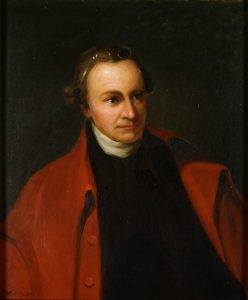
Patrick Henry
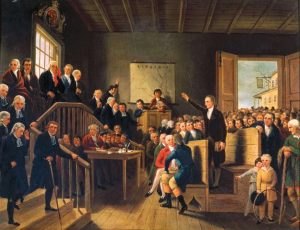
Patrick Henry speaking in an Assembly