
Benjamin Franklin
Benjamin Franklin was one of the most important delegates to the 1787 Constitutional Convention. Because he brought no new ideas to the Convention and did not deliver remarks that changed the course of the Convention’s proceedings, his importance was largely symbolic. In 1787, Franklin and George Washington were venerated as the two greatest living Americans—the diplomatic and the military heroes of the Revolution. By merely attending the Convention, their imprimatur gave Americans confidence that the outcome of the Convention would be beneficial rather than dangerous. The fact that Franklin was eighty-two years old and that Washington had voluntarily surrendered his commission as commander-in-chief at the end of war seemed to assure Americans that these two statesmen would not betray their country.
On 17 September 1787, as the Convention’s final session finished reading the Constitution, an enfeebled Franklin asked his fellow Pennsylvania delegate James Wilson to read a speech that contained Franklin’s reasons for supporting the Constitution—even though he did not approve every provision. Franklin did not list his objections, nor did he express them outside the Convention. He believed that a strong central government was needed and doubted that any other convention could produce a better constitution. Franklin was astonished that the Constitution approached “so near to perfection.” He expected “no better” and was “not sure that it is not the best.” To inspire greater public confidence in the document, Franklin asked each delegate to sign the Constitution. All but three delegates complied. Two days later, the
Pennsylvania Gazette reported that the speech was “extremely sensible” and that Franklin’s support of the Constitution would encourage all his Pennsylvania friends to favor the Constitution.
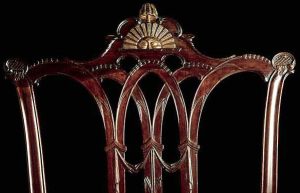
Chair with rising sun
According to James Madison’s notes, while the last delegates were signing the Constitution, “Doctr. Franklin looking towards the President’s Chair, at the back of which a rising sun happened to be painted, observed to a few members near him, that Painters had found it difficult to distinguish in their art a rising from a setting sun. I have said he, often and often in the course of the Session, and the vicissitudes of my hopes and fears as to its issue, looked at that behind the President without being able to tell whether it was rising or setting. But now at length I have the happiness to know that it is a rising and not a setting sun.”
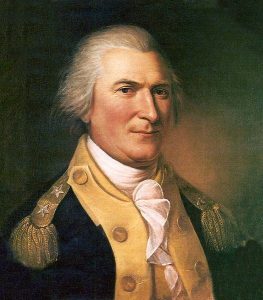
Nathaniel Gorham
On 30 October 1787, Massachusetts delegate Nathaniel Gorham asked Franklin for a copy of his speech. Gorham believed that its publication might influence “some few honest men” in Massachusetts who were not in favor of the Constitution. Two weeks later on 14 November, Franklin replied that “I have hitherto refused to permit its Publication: But your Judgment that it may do good weighs much more with me than my own Scruples. I therefore enclose it, and it is at your Disposition.”

Boston Gazette masthead 1787
On the advice of friends, Gorham deleted portions of the speech and the
Boston Gazette printed it on 3 December, stating that it was “authentic—coming from a gentleman of respectability.” By 21 December this version of the speech was reprinted in twenty-six newspapers in the Northern States.
Gorham informed Franklin on 15 December that almost everyone “read and applauded” the speech and that it had been “much used” in town meetings “to inculcate moderation & a due respect to the opinion of others.” However, some Antifederalists criticized Franklin for signing the Constitution despite the serious doubts that he had about it. In turn, these detractors were themselves vilified. “Clito,” writing in the
Massachusetts Gazette on 18 December, defended the elder statesman. “There is something in age which commands the respect even of savages; it is a duty which nature dictates, to treat our sires with veneration, and the wretch who is destitute of this principle, can justly anticipate nothing but contempt, should he be cursed with longevity.” According to “Clito,” Franklin’s speech was “justly admired by all the friends to a federal system; & the attempts to blacken a character so perfectly invulnerable to the squibs of such scribblers, sufficiently discovers to what pitiful shifts the anti-federalists are reduced.”
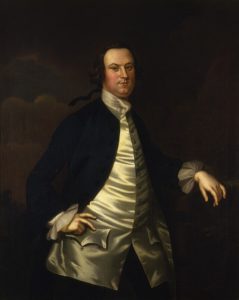
Daniel Carroll
Franklin also sent a copy of his speech to Daniel Carroll, a Maryland delegate to the Constitutional Convention. At the behest of the Maryland House of Delegates, Maryland’s Convention delegates appeared before it in Annapolis on 29 and 30 November. On 2 December, Carroll informed Franklin that he had read the speech to the House in order to refute statements by fellow Convention delegate Luther Martin, whom he believed had misrepresented Franklin. Carroll apologetically told Franklin that he “had not communicated” the speech “to any but Messrs. Ths Johnson, Mr. [Charles] Carroll of Carrollton & my Brother [John Carroll] until this occasion, nor have I sufferd any Copy to be taken nor will not
without your permission to persons
I can depend on to be used occasionally for the same purpose I have done it, or will do any thing else with them you may require.” Carroll sheepishly asked Franklin to honor him “with a few lines that may relieve me from the anxiety I now feel.”
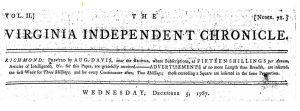
Virginia Independent Chronicle masthead
On 5 December, three days after Carroll had written to Franklin, the Richmond
Virginia Independent Chronicle printed a version of the speech almost identical with the copy Franklin had sent to Carroll. “A.B.,” who requested the
Chronicle to publish the speech, said that he did not want to displease Franklin but that “the risque of offending him is over-balanced by the service I may render my country in disseminating those principles it contains, of modest deference for the opinions of others.” By 16 February 1788 the
Chronicle’s version was reprinted in ten newspapers from Pennsylvania to Georgia, in the December 1787 issue of the Philadelphia
American Museum, and in a Richmond pamphlet anthology.
Franklin’s Speech:
Virginia Independent Chronicle
I confess that I do not entirely approve of this Constitution at present, but Sir, I am not sure I shall never approve it: For having lived long, I have experienced many Instances of being oblig’d, by better Information or fuller Consideration, to change Opinions even on important Subjects, which I once thought right, but found to be otherwise. It is therefore that the older I grow the more apt I am to doubt my own Judgment and to pay more Respect to the Judgment of others. Most Men indeed as well as most Sects in Religion, think themselves in Possession of all Truth, and that wherever others differ from them it is so far Error. [Sir Richard] Steele, a Protestant, in a Dedication tells the Pope, that the only Difference between our two Churches in their Opinions of the Certainty of their Doctrine, is, the Romish Church is infallible, and the Church of England is never in the Wrong. But tho’ many private Persons think almost as highly of their own Infallibility, as that of their Sect, few express it so naturally as a certain French lady, who in a little Dispute with her Sister, said, I don’t know how it happens, Sister, but I meet with no body but myself that’s
always in the right.
Il n’y a que moi qui a toujours raison.
In these Sentiments, Sir, I agree to this Constitution, with all its Faults, if they are such: because I think a General Government necessary for us, and there is no
Form of Government but what may be a Blessing to the People if well administred; and I believe farther that this is likely to be well administred for a Course of Years, and can only end in Despotism as other Forms have done before it, when the People shall become so corrupted as to need Despotic Government, being incapable of any other. I doubt too whether any other Convention we can obtain, may be able to make a better Constitution: For when you assemble a Number of Men to have the Advantage of their joint Wisdom, you inevitably assemble with those Men all their Prejudices, their Passions, their Errors of Opinion, their local Interests, and their selfish Views. From such an Assembly can a perfect Production be expected? It therefore astonishes me, Sir, to find this System approaching so near to Perfection as it does; and I think it will astonish our Enemies, who are waiting with Confidence to hear that our Councils are confounded, like those of the Builders of Babel, and that our States are on the Point of Separation, only to meet hereafter for the Purpose of cutting one another’s Throats. Thus I consent, Sir, to this Constitution because I expect no better, and because I am not sure that it is not the best. The Opinions I have had of its Errors, I sacrifice to the Public Good. I have never whisper’d a Syllable of them abroad. Within these Walls they were born, & here they shall die. If every one of us in returning to our Constituents were to report the Objections he has had to it, and endeavour to gain Partizans in support of them, we might prevent its being generally received, and thereby lose all the salutary Effects & great Advantages resulting naturally in our favour among foreign Nations, as well as among ourselves, from our real or apparent Unanimity. Much of the Strength and Efficiency of any Government, in procuring & securing Happiness to the People depends on Opinion, on the general Opinion of the Goodness of that Government as well as of the Wisdom & Integrity of its Governors. I hope therefore that for our own Sakes, as a Part of the People, and for the Sake of our Posterity, we shall act heartily & unanimously in recommending this Constitution, wherever our Influence may extend, and turn our future Thoughts and Endeavours to the Means of having it well administred.
On the whole, Sir, I cannot help expressing a Wish, that every Member of the Convention, who may still have Objections to it, would with me on this Occasion doubt a little of his own Infallibility, and to make
manifest our
Unanimity, put his Name to this Instrument.