Lost and Found: New Hampshire’s Founding Documents
As a 24-year-old graduate student at the University of Wisconsin–Madison I had a quarter-time appointment working as a project assistant for my major professor, Merrill Jensen, who was then editing the Documentary History of the First Federal Elections. (This four-volumes series was published between 1976 and 1989.) I had come to the UW with a master’s degree, hoping to obtain a Ph.D. in early American history.
In August 1969, I planned to go on the road in New York, New Jersey, and Rhode Island to complete research for my dissertation. Professor Jensen offered to pay for my entire two-month research trip if I would be willing to do some additional research for the Election Project along with three other federally sponsored projects: the First Federal Congress Project, the Documentary History of the Ratification of the Constitution and the Bill of Rights, and the supplemental volume for Max Farrand’s Records of the Federal Convention of 1787. I agreed to this arrangement.
 One of the last stops on the research trip was Concord, N.H. Unfortunately, almost immediately after starting my research there, my new camera broke. It was a single lens reflex camera—not a cell phone camera—that I used to photograph documents for microfilm. Each evening, I developed the film myself in my hotel bathroom. No local camera retail stores could help me, but I was told about a repairman who had recently moved to Goshen, N.H., about fifty miles west of Concord, who might be able to repair my camera. I drove to Goshen, in the foothills of the Pillsbury-Sunapee Highlands. Being mid-October, it was a fantastically beautiful drive during the height of the fall foliage season. A short distance from the intersection of two county roads, the repairman had two mobile trailers—a family residence for him, his wife and their baby boy, and the other his repair shop. After two hours of work, he got the camera working again—and charged me just $2! (It was 1969, after all.)
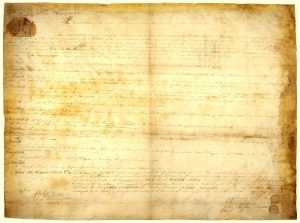
The following Monday, I resumed the research for the four federal government projects. After finishing the research at the N.H. Historical Society, the State Library, and the new State Archives, I asked an archivist if there were any other places in Concord that might have eighteenth-century documents. She suggested that I might check at the Secretary of State offices, because that is where the archival documents had been stored before the opening of the new Archives building. Following this advice, I walked to the Secretary of State office and asked a receptionist if they had any eighteenth-century documents. She seemed flummoxed but suggested that I might look around the large sprawling office room that we were in. It contained twenty to thirty desks and as many employees. Security was not a big issue at that time. As I browsed around the room, I spotted two documents each rolled up separately atop a metal supply cabinet. I pulled them down and much to my amazement they were:
One of the last stops on the research trip was Concord, N.H. Unfortunately, almost immediately after starting my research there, my new camera broke. It was a single lens reflex camera—not a cell phone camera—that I used to photograph documents for microfilm. Each evening, I developed the film myself in my hotel bathroom. No local camera retail stores could help me, but I was told about a repairman who had recently moved to Goshen, N.H., about fifty miles west of Concord, who might be able to repair my camera. I drove to Goshen, in the foothills of the Pillsbury-Sunapee Highlands. Being mid-October, it was a fantastically beautiful drive during the height of the fall foliage season. A short distance from the intersection of two county roads, the repairman had two mobile trailers—a family residence for him, his wife and their baby boy, and the other his repair shop. After two hours of work, he got the camera working again—and charged me just $2! (It was 1969, after all.)
The following Monday, I resumed the research for the four federal government projects. After finishing the research at the N.H. Historical Society, the State Library, and the new State Archives, I asked an archivist if there were any other places in Concord that might have eighteenth-century documents. She suggested that I might check at the Secretary of State offices, because that is where the archival documents had been stored before the opening of the new Archives building. Following this advice, I walked to the Secretary of State office and asked a receptionist if they had any eighteenth-century documents. She seemed flummoxed but suggested that I might look around the large sprawling office room that we were in. It contained twenty to thirty desks and as many employees. Security was not a big issue at that time. As I browsed around the room, I spotted two documents each rolled up separately atop a metal supply cabinet. I pulled them down and much to my amazement they were:
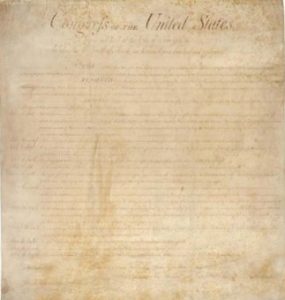 President George Washington had sent each state an engrossed list of the amendments on 2 October 1789 that was to be submitted to the state legislature for approval. Any of those amendments ratified by three-quarters of the states would become part of the Constitution. Of the twelve amendments proposed, ten were ultimately ratified by the end of 1791 and became what we now refer to as the Bill of Rights. I immediately took the documents to the receptionist and informed her of their historical importance and value. I also asked if I could get copies of the two documents. I was told that they did not have a big enough copier available to make copies for me. I left my name and address. When I returned to Madison, I described my adventure to Professor Jensen. He insisted that I should make a report in our next seminar session. Not long after, I received a large photographic negative and a 9”x10” glossy print of each document with an invoice for $50.
In 1976 a newspaper in Durham, N.H., mentioned the lost documents that had recently been discovered. But there was no mention of my name. Twelve years later, in 1988, the Council of the Original Thirteen States sponsored an elaborate bi-centennial celebration of the ratification of the Constitution in Concord. As the ninth state to ratify, New Hampshire had provided the decisive vote required for the implementation of the Constitution. U.S. Supreme Court Chief Justice William Rehnquist even spoke. I attended the celebration and was pleased to formally present the Chief Justice a copy of a new anthology describing each state’s ratification of the Constitution that I had co-edited with my colleague Patrick T. Conley of Providence, R.I. I was also pleased to see that New Hampshire had provided free copies of the retained form of ratification that I had found almost twenty years ago, for people attending the celebration. It was at this meeting that I finally shared my story with a reporter. That marked the end of my involvement with the documents and any public report of my findings.
Recently, however, I was emailed a newspaper account from the Greenfield, Mass., Recorder dated 29 November 1978. It reported that the list of Amendments (along with a couple other documents) had been located rolled up in a long tin tube in a vault in the Secretary of State’s Office. William Gardner, the Secretary of State, indicated that the document was long thought to be located in a government building, but because its exact location was unknown, it was “considered lost.”
I don’t know what happened to the documents after I left them with the receptionist at the Secretary of State’s office in October 1969. Perhaps, for safekeeping, they were put into a tin tube and placed in a vault at that time.
President George Washington had sent each state an engrossed list of the amendments on 2 October 1789 that was to be submitted to the state legislature for approval. Any of those amendments ratified by three-quarters of the states would become part of the Constitution. Of the twelve amendments proposed, ten were ultimately ratified by the end of 1791 and became what we now refer to as the Bill of Rights. I immediately took the documents to the receptionist and informed her of their historical importance and value. I also asked if I could get copies of the two documents. I was told that they did not have a big enough copier available to make copies for me. I left my name and address. When I returned to Madison, I described my adventure to Professor Jensen. He insisted that I should make a report in our next seminar session. Not long after, I received a large photographic negative and a 9”x10” glossy print of each document with an invoice for $50.
In 1976 a newspaper in Durham, N.H., mentioned the lost documents that had recently been discovered. But there was no mention of my name. Twelve years later, in 1988, the Council of the Original Thirteen States sponsored an elaborate bi-centennial celebration of the ratification of the Constitution in Concord. As the ninth state to ratify, New Hampshire had provided the decisive vote required for the implementation of the Constitution. U.S. Supreme Court Chief Justice William Rehnquist even spoke. I attended the celebration and was pleased to formally present the Chief Justice a copy of a new anthology describing each state’s ratification of the Constitution that I had co-edited with my colleague Patrick T. Conley of Providence, R.I. I was also pleased to see that New Hampshire had provided free copies of the retained form of ratification that I had found almost twenty years ago, for people attending the celebration. It was at this meeting that I finally shared my story with a reporter. That marked the end of my involvement with the documents and any public report of my findings.
Recently, however, I was emailed a newspaper account from the Greenfield, Mass., Recorder dated 29 November 1978. It reported that the list of Amendments (along with a couple other documents) had been located rolled up in a long tin tube in a vault in the Secretary of State’s Office. William Gardner, the Secretary of State, indicated that the document was long thought to be located in a government building, but because its exact location was unknown, it was “considered lost.”
I don’t know what happened to the documents after I left them with the receptionist at the Secretary of State’s office in October 1969. Perhaps, for safekeeping, they were put into a tin tube and placed in a vault at that time.
Goshen, N.H. in fall
New Hampshire Ratifies June 21, 1788 and Constitution Becomes Effective
- (1) The engrossed form of ratification from the New Hampshire Ratifying Convention, dated 21 June 1788; and
- (2) New Hampshire’s copy of the engrossed list of Congress’ twelve amendments to the Constitution that was signed by Frederick Augustus Muhlenberg as Speaker of the House of Representatives and John Adams as President of the Senate.
Engrossed manuscript of Congress’ proposed twelve amendments to the Constitution